Change in Action for the 16 Days of Activism

Change in Action for the 16 Days of Activism

Wednesday 25 November 2026

down arrow

Today marks the beginning of the 16 Days of Activism against Gender-Based Violence and the launch of our 2026 campaign, Change in Action.

Over the last few years, we have utilised the 16 Days of Activism to explore and celebrate the incredible efforts of our sector, the hope we hold for a future free from family and gender-based violence, and the ways our work helps sustain that hope.  

This year, Change in Action will showcase the work of practitioners and activists who are making a meaningful difference in efforts to end family and gender-based violence. While their approaches may differ, they share a vision of a world where every person can live with safety, dignity and respect. 

Building on our previous 16 Days themes of Hope in Action and Changemakers, this year’s campaign continues our exploration of what it takes to create lasting social change. Over the past three years, we have celebrated the hope that inspires us, the people who champion progress and the collective efforts that bring a different future within reach. We also know that much of this work happens quietly – through advocacy, everyday actions and community-led initiatives that don’t always receive the recognition they deserve. 

Creating meaningful change – especially in our sector – takes time, persistence and courage. Alongside important advances in policy, investment and practice, we are seeing growing resistance to social change and increasingly divided conversations about equality and violence. In this environment, it is more important than ever to recognise and amplify the people who continue to show up, challenge harmful attitudes and push for a safer future. Change in Action is an opportunity to bring their work into the spotlight and acknowledge the impact they make, often without fanfare but never without purpose. 

At a time when the world feels particularly fragmented, I am reminded of a line from our 2023 article Nurturing Hope: 

“Nurturing and maintaining hope in our efforts to address family and gender-based violence is an active pursuit…. Hope can be angry. It can be fierce. It can be an act of defiance against detractors.” 

Hope encourages action, and action creates change. Each project, each act of advocacy, each person who shows up every day to do the work is part of a collective movement for change. From sweeping state-wide reforms to local initiatives, meaningful change is created in our communities every day, by ordinary people doing extraordinary things.  

The ability to create change in action lives in all of us. For Victorians, the 16 Days of Activism coincides with our State Election on Saturday 28 November. The act of voting is perhaps the greatest lever we have to generate long-term change, and I encourage everybody heading to the polls to consider what commitments all candidates have made to address family and gender-based violence in our state.  

We know progress is never linear, and change takes time – but it is possible, and in fact it is happening. I hope this campaign can serve as a reminder that family and gender-based violence is not inevitable. It is possible to live in a world where acts of violence are few and far between, and every person can participate and access the supports they need, when they need them, no matter their circumstances. I am immensely proud to showcase some of the brilliant practitioners and advocates across Victoria who are bringing us closer to that future.  

Read more about them and our Change in Action campaign here.  

Dr Joumanah El-Matrah,
CEO, Safe and Equal 

Page last updated Wednesday, November 25 2026
KEEP
UP TO DATE

By subscribing to our regular bulletins.

Family Violence Intervention Orders for Children and Young Adults: Stage 2 – Participation in Court Proceedings

Family Violence Intervention Orders for Children and Young Adults: Stage 2 – Participation in Court Proceedings

13 November 2026

down arrow

Children and young people must be recognised as victim survivors in their own right, and participate independently and safely in Family Violence Intervention Order Proceedings if they choose to do so.

All services must be able to give children and young people age-appropriate, trauma-informed and culturally appropriate and holistic support throughout the FVIO process. However, there are gaps in the broader service system including a lack of resources for the Specialist Family Violence System, therapeutic supports and availability of appropriately skilled lawyers.

In addition, there remains the need to balance the voice of children and young people with protection from the court system.

Safe and Equal makes seven recommendations to improve responses to Children and Young People to ensure safe and independent participation in FVIO proceedings.

Page last updated 17 November 2026.

KEEP
UP TO DATE

By subscribing to our regular bulletins.

Statement on the Victorian Government’s election commitments

Statement on the Victorian Government’s election commitments

Tuesday 10 November 2026

down arrow

Safe and Equal welcomes the Victorian Government’s election commitment for family violence support services and early intervention, recognising the importance of a well-resourced specialist sector and ensuring victim survivors can access support before violence escalates to crisis. 

We welcome the $15.5 million investment in family violence support workers and The Orange Door, a vital boost that will extend access and support to an additional 10,000 clients. Building on this positive step, continuing to expand capacity across the broader specialist family violence system will ensure that growing demand at entry points is fully matched by ongoing, tailored case management. 

Sustained investment across all specialised services will allow us to deliver seamless, comprehensive care for every person reaching out for help. The $16 million over four years for early intervention is also a welcome recognition that preventing family violence requires action well before people reach crisis point, including better coordination across health, community and social services. To maximise the impact of this initiative, sustained investment in specialist family violence services must remain central to ongoing sector funding. 

We also acknowledge the Government’s commitments around restrictions on smart glasses in certain settings and measures to address the use of online dating platforms by people convicted of family or sexual violence offences. As technology and online environments create new and emerging avenues for abuse and harm, it is important that these risks are recognised and addressed. These commitments send an important signal that safety must be considered across all spaces where people live, work, connect and seek support. 

As the peak body for specialist family violence organisations specialising in prevention, early intervention, response and recovery in Victoria, Safe and Equal has consistently advocated for sustained investment, stronger system coordination and a greater focus on early intervention. We look forward to working constructively with the Government to ensure these commitments are implemented in genuine partnership with the specialist family violence sector and informed by the lived experience of victim survivors. 

Enhanced frontline support and early intervention build directly on existing commitments – including four-year funding cycles, a new 10-year strategy and protected Royal Commission services. Together, they reflect an expanding policy framework for family violence in Victoria. Victim survivors deserve a comprehensive vision – and the sustained support to deliver it. 

More information on the Victorian Government’s announcement can be found here.


About Safe and Equal: standing strong against family violence 

Safe and Equal is the peak body for Victorian organisations specialising in family and gender-based violence across prevention, early intervention, response and recovery. Our vision is a world where everyone is safe, respected and thriving, living free from family and gender-based violence.  


Media contact  

media@safeandequal.org.au  

Page last updated Tuesday, November 10 2026

KEEP
UP TO DATE

By subscribing to our regular bulletins.

16 Days of Activism – Change in action

16 Days of Activism against Gender-Based Violence

Quote icon-05

Hope encourages action, and action creates change. Each project, each act of advocacy, each person who shows up every day to do the work is part of a collective movement for change.

From sweeping state-wide reforms to local initiatives, meaningful change is created in our communities every day, by ordinary people doing extraordinary things.

16 Days 2025 Changemakers square (16)

Dr Joumanah El-Matrah

CEO
Safe and Equal

Read Joumanah’s 16 Days of Activism blog post here.

Welcome to the 16 Days of Activism 2026

Every day at Safe and Equal, we’re working towards a world where everyone is safe, thriving and living free from family and gender-based violence. As the peak body for Victorian organisations across the sector, we’re incredibly proud of the fiercely dedicated and passionate workforce who share this goal. 

Last year, to commemorate the 16 Days of Activism against Gender-Based Violence*, our campaign centred on Changemakers working hard to address violence in different parts of the community. We spotlighted several organisations and advocates who are dedicated to changing attitudes, behaviours, systems and lives. 

In 2026 we will be expanding on this theme by exploring Change in Action. We will be focusing on the tangible actions of practitioners and advocates working across prevention, early intervention and response and the practical outcomes of their advocacy. We hope that by showcasing the variety of dedicated individuals and initiatives across the sector, we can demonstrate how, as a movement, we’re collectively turning action into change. 

This year’s campaign will be more interactive than ever and we’d love you to get involved. Find out more below about how you can join the campaign, share what your activism looks like and showcase the collective power of change in action.  

*Each year, the 16 Days of Activism against Gender-Based Violence takes place from 25 November (the International Day for the Elimination of Violence against Women) to 10 December (International Human Rights Day). This global campaign (running since 1991!) provides an opportunity for individuals, organisations and communities to unite and collectively advocate for the elimination of gender-based violence. 

These hardworking advocates are dedicated to creating real and lasting change across Victoria and beyond.

From survivor healing groups to national rallies, specialist support services to education and awareness-raising, training and upskilling the workforce to changing systemic policies and laws, these influential advocates and practitioners are working towards one common goal: ending family and gender-based violence.

Read about their different forms of activism below and how they’re collectively changing the world we live in.

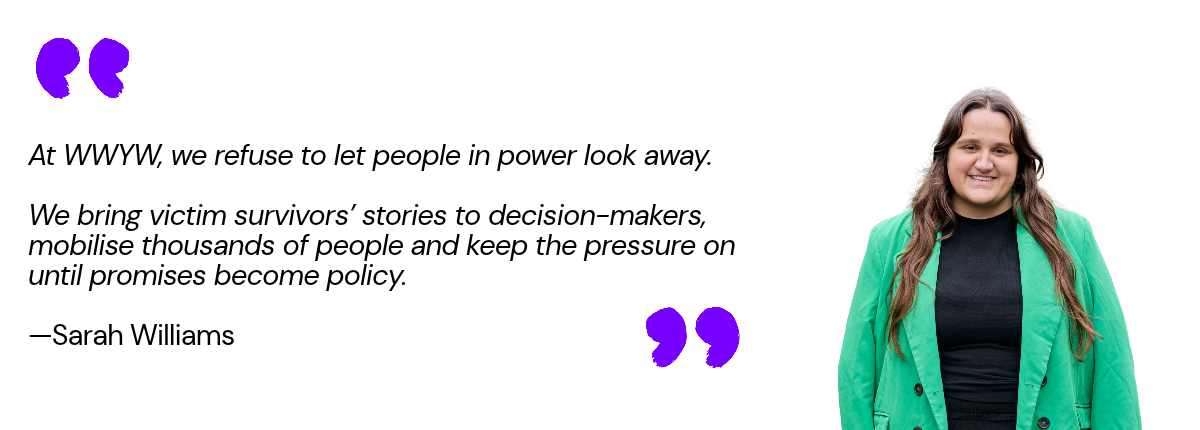
Sarah Williams, What Were You Wearing
Sarah Williams is a proud Aboriginal woman and the Founder and CEO of What Were You Wearing Australia (WWYW), a First Nations-led national charity working to end sexual violence and support victim survivors.  

Sarah brought the original WWYW exhibition to Australia from the US in 2021, collecting over 9,000 survivor stories, voices too often ignored or silenced. That moment was a turning point. Sarah knew WWYW couldn’t be just a once-a-year event. She wanted to create a movement. A daily support system and platform to empower survivors and change the conversation around violence. 

From this vision, What Were You Wearing became the organisation it is today – a lifeline for survivors and a catalyst for change. 

Today, WWYW’s work combines advocacy, direct support and education. Sarah and the team are creating real, measurable change through:  

  • Policy change: in 2023, their advocacy led to mandated drink spiking, sexual assault and harassment training for all bar staff in NSW. This makes nightlife safer for thousands of people every weekend.  
  • National mobilisation and political engagement: in 2024, Sarah and the team organised the No More rallies, the largest gender-based violence rallies in Australia’s history. Anthony Albenese attended and declared gender-based violence a national emergency.  
  • Direct support: for more than three years, WWYW’s free Survivor Healing Groups have run every month in over eight locations. They are led by mental health professionals and give victim survivors a safe place to heal and connect.  
  • Education and awareness: through WWYW’s workplace and nightlife education programs and a social media community of more than 500,000 people, they are shifting attitudes, challenging victim-blaming and equipping people to prevent violence.  

Everything WWYW does is grounded in survivor voices and driven by a dedicated team across Australia – most of them volunteers – who believe a future without sexual violence is possible. 

Learn more about Sarah’s work with WWYW here.  

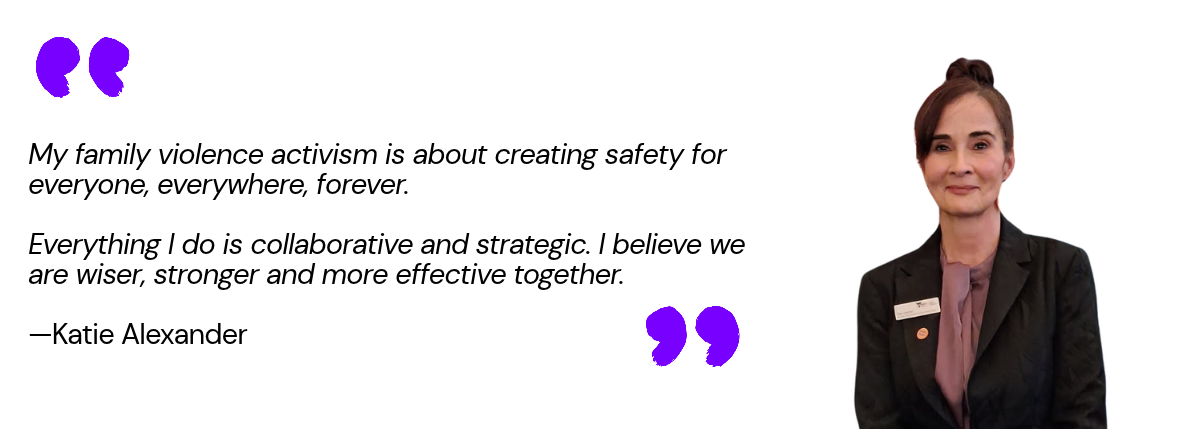
Katie Alexander, survivor advocate
Katie Alexander is committed to creating safety for everyone. This guides her as a changemaker who champions the rights of all people to live free from danger, discrimination and disadvantage in safe, equal and connected communities. Katie weaves together her experiences of violence, disease and disability, offering her personal insights and the collective insights of victim survivors to help people understand the complex impacts of family and sexual violence. Much of Katie’s advocacy is unseen. She quietly accompanies people from danger to safety; from isolating illness to belonging; from disability exclusion to inclusion; and from fear to freedom.  

Katie is a writer, speaker, researcher and advisor working in governance roles and in groups with community organisations, government, universities, business and charities. She is co-creating transformative change for all Victorians as Co-Chair of the Government’s Victim Survivor’s Advisory Council, and as a co-researcher with the Safer Families Centre’s WEAVERS Network. 

Katie influences law reform by strategically sharing the lived expertise of people with diverse identities. Drawing on her careers as a journalist, social worker and counsellor, her advocacy seeks to rehumanise systems so that survivors are at their core and leading innovation in service design, delivery, research and practice. 

In 2025 Katie addressed nearly 11,000 Victorians at the 2025 Respect Victoria Walk Against Family Violence advocating for greater understanding of intergenerational abuse. At the 2025 Safe Steps Vigil, she amplified the political influence of lived expertise by addressing her speech about the lives lost and the impact on families, friends and communities to the Premier and the Federal Attorney General. Also, at the 2017 and 2024 Safe Steps Vigils, she called upon more than 1000 people to create safety in their communities. 

Ending the preventable murder of women, gender-diverse people and children motivates Katie in her activism. Her 14-year experience of legal abuse and decades of medical trauma have honed the creative ways Katie advocates for change. From testifying before a Federal Family Law Enquiry in 2017, then recently in Victorian Law Reform Commission hearings, and developing new safety laws with the Department of Justice and Community Safety.  

In 2026, Katie’s advocacy – based on her own experiences of stalking, coercive control and intervention orders – came to fruition in laws that she announced with the Victorian Premier and the Attorney General. She also helped launch Respect Victoria’s See the Signs education campaign with the Minister for the Prevention of Family Violence, Sonya Kilkenny and 2015 Australian of the Year Rosie Batty.  

A pivotal moment of Katie’s advocacy against violence towards people living with disability was her private meeting with the Minister for the National Disability Insurance Scheme Bill Shorten in 2022. She described the compounding effects of family violence, disability discrimination and disadvantage and how this guided her advisory roles in an NDIS Select Committee and a Safeguarding Working Group and in volunteering with children in the Making Waves Foundation disabled sailing programs. 

Learn more about Katie’s work with the Victim Survivor’s Advisory Council here. 

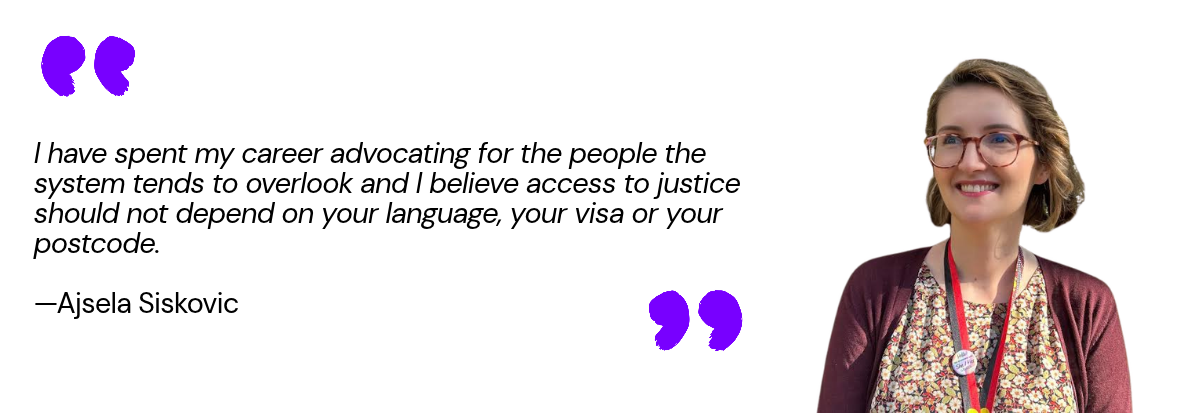
Ajsela Siskovic, inTouch
Ajsela Siskovic leads intouch Women’s Legal Centre, a specialist community legal centre within intouch Multicultural Centre Against Family Violence. They provide free, in-language, culturally appropriate legal advice and representation to migrant and refugee women experiencing family violence, across the intersection of family violence, family law, migration and victims of crime matters.  

The Centre’s work is built on an integrated model where lawyers work alongside intouch case managers to provide holistic and culturally tailored support for the women escaping family violence. This ensures that the legal, safety and practical needs of people escaping violence are addressed together by people who understand the language, culture and migration journey. A major barrier for clients is a limited understanding of how the Australian legal system and government agencies work, so Ajsela and her colleagues explain each step in a woman’s own language and structure the support so that women can navigate complex legal systems.  

The outcomes are practical and lasting. The women the Centre supports secure intervention orders that keep them and their children safe, parenting arrangements that protect their children and visa pathways that do not depend on the person who harmed them. In 2025-26, the Centre assisted 649 women with 477 legal advice services alongside legal tasks, ongoing legal support and representation.  Importantly, around 137 women obtained permanent residency and safety through their legal support. Each outcome removes a barrier to justice and supports a woman’s long-term safety, recovery and stability.  

The change does not stop with the individual clients. Ajsela and her team take what they see in casework to government and the media, contributing to law reform consultations and calling for sustainable, flexible funding and for support that does not depend on a woman’s visa status. Each client’s experience helps shift the system for the next woman who needs it.  

That is the real change: specialist, culturally responsive legal help that utilises the combination of legal and family violence systems into improving the daily lives of women and their children. 

Learn more about Ajsela‘s work with inTouch Women’s Legal Centre here. 

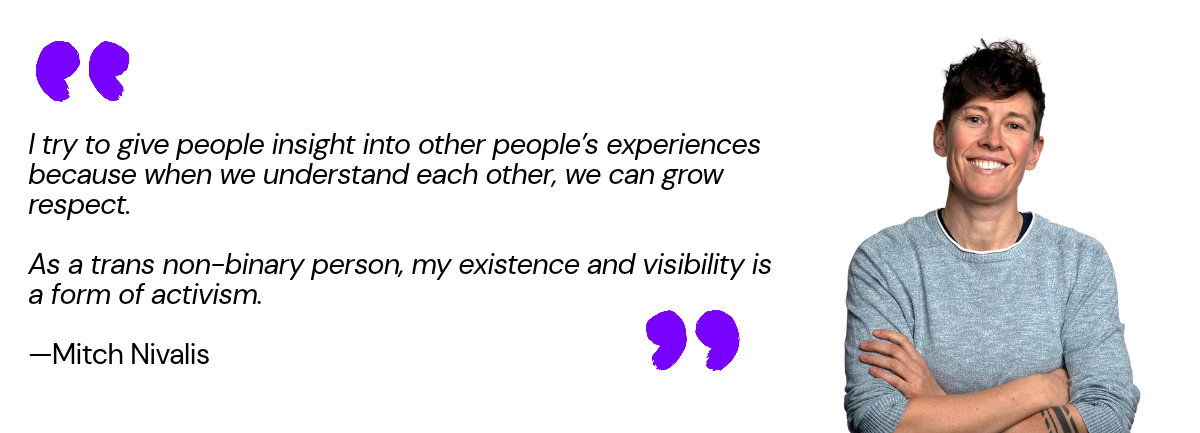
Mitch Nivalis, Proud 2 Play
Mitch Nivalis is the National Program Director for Proud 2 Play, working on education and expanding their Rainbow Ready Clubs program, an innovative initiative designed to transform sports clubs into inclusive and supportive environments for LGBTIQA+ individuals. Mitch started in this role in 2025 after running a film production company for 20 years and recently releasing their own feature documentary film Equal the Contest. The film focuses on gender equity and LGBTIQA+ inclusion in sport, bringing Mitch’s storytelling skills to the sports sector.  

Prevention of violence has always been at the forefront of their work, particularly as a tool for distilling complex ideas into engaging content. Now in their role at Proud 2 Play, Mitch uses sport as a conduit for understanding.   

Proud 2 Play works on a number of levels to create change – advocating for individuals who need support to work through experiences of discrimination or harm in sport, events to create visibility and provide safe spaces for people to celebrate and be celebrated in sport and education to help people understand and take action on the barriers that exist for LGBTIQA+ people in sport along with the benefits more inclusive spaces create for everyone.   

LGBTIQA+ inclusion work is inherently tied to the primary prevention of gender-based violence. When Proud 2 Play do this work, they’re breaking down gender roles and stereotypes, moving away from gendered language, reshaping traditionally hyper masculine sports spaces and creating strong foundations for respect.   

There are two specific education pieces Mitch has been working on since joining Proud 2 Play. The first was reimagining some of the education workshops into immersive game-based experiences. These allow participants to have a moment in someone else’s shoes and experience the barriers for LGBTIQA+ people in sport firsthand. The workshop has sparked incredible curiosity, reflection and conversations. Clubs walk away with simple, free and clear ideas to create change.   

The second has been expanding the Rainbow Ready Clubs program across Australia and building a Train the Trainer program so they can reach more clubs sustainably. The long-term program maps primary prevention frameworks and allows Proud 2 Play to help whole clubs embed change and bring their members along for the journey.   

The benefit of this work is not just for LGBTIQA+ people in Australia. When sporting clubs create change in this way, the environments are safer and more welcoming for everyone, including men and boys. 

Learn more about Mitch’s work and Proud 2 Play here.

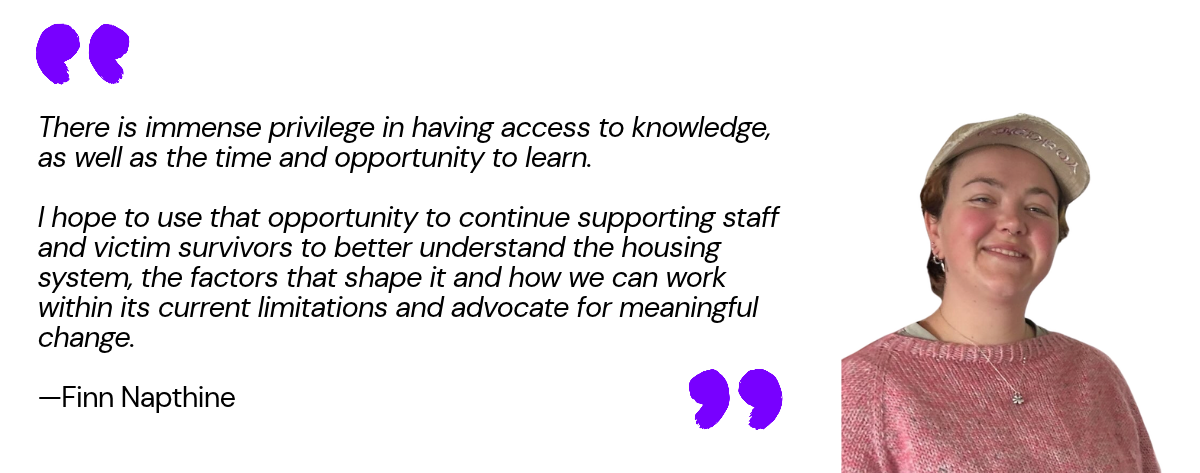
Finn Napthine, GenWest
In their role as Housing Pathways Coordinator at GenWest, Finn Napthine builds family violence workers’ understanding of the housing system and how to navigate it, while equipping them with the skills to have transparent conversations with clients about their housing options. They achieve this primarily through training and secondary consultations. 

Finn collaborates with other Housing Pathways Coordinators to develop and deliver joint training across services. This helps ensure equitable access to information, promotes shared understanding across sectors and strengthens interagency relationships.  

Finn also supported the development of the Western Homelessness and Family Violence Alliance, a monthly forum where services come together to share resources, consult with one another and provide updates. This has enabled services to better understand both shared and service-specific challenges, openly discuss capacity constraints and barriers and collectively advocate for change. 

Finally, they collate and analyse data to identify trends within the crisis response model, including common housing pathways and barriers experienced by victim survivors. This helps identify areas of concern and opportunities to improve practice.  

Some key achievements have included:  

  • Developing training for hotel and motel staff to build their understanding of family violence and the crisis response model, improving the experiences of victim survivors accessing emergency accommodation.  
  • Developing and delivering training on homelessness, housing options and social housing, both internally and through local Orange Door services.  
  • Strengthening relationships between local family violence and homelessness services, resulting in improved collaboration, greater mutual understanding and better outcomes for clients. 

Learn more about Finn‘s work with GenWest here. 

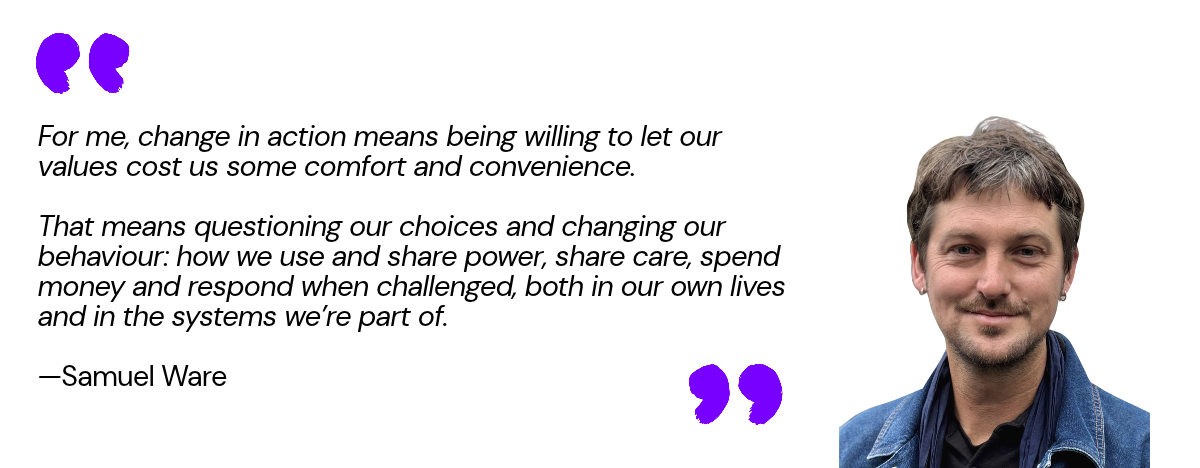
Samuel Ware, The Men’s Project
Samuel Ware is Executive Director of The Men’s Project at Jesuit Social Services, collaborating to prevent men’s violence and child sexual abuse and build care, accountability and healthy relationships. 

His team develops knowledge through research, evaluation, practice and lived experience, and translates it into programs, resources and advocacy. They work with people to strengthen connections and challenge harmful gender norms; with schools, workplaces and communities to embed prevention in established relationships and settings; and with partners and government to shape and sustain systems. 

Their work is guided by the leadership, knowledge and experience of women, LGBTIQA+ communities, victim-survivors and First Nations peoples. 

Compassionate accountability is central to The Men’s Project’s approach: engaging people with curiosity, care and dignity while prioritising safety, managing risk and resisting collusion, to create the conditions for responsibility, choice and change. 

Recent contributions from The Men’s Project include:  

  • Release of the Adolescent Man Box research, examining how restrictive masculine norms relate to boys’ wellbeing, harmful attitudes and behaviour, and informing prevention. 
  • Launch of What’s OK? Australia, offering young people anonymous information and support with questions or concerns about sexual thoughts, behaviours and relationships. 
  • Refining and expanding prevention and early intervention work in schools, community sport and construction. 
  • Partnering with Equimundo and WOW on the MenCare Changemaker Journey, a global initiative to promote caring manhood and change how care is valued and shared. 

The Men’s Project is grounded in Jesuit Social Services’ broader social change work to build a just society. This includes promoting the connections between social and environmental justice, and the importance of healthy relationships between people, place and planet. 

Over 2025–26, Jesuit Social Services supported more than 9,000 people through direct services; facilitated nearly 160,000 engagements with people, including through group programs, workshops and events; and created more than 700,000 opportunities to change hearts and minds through the reach of its media, publications, online resources and advocacy.  

Learn more about Sam’s work with The Men’s Project here. 

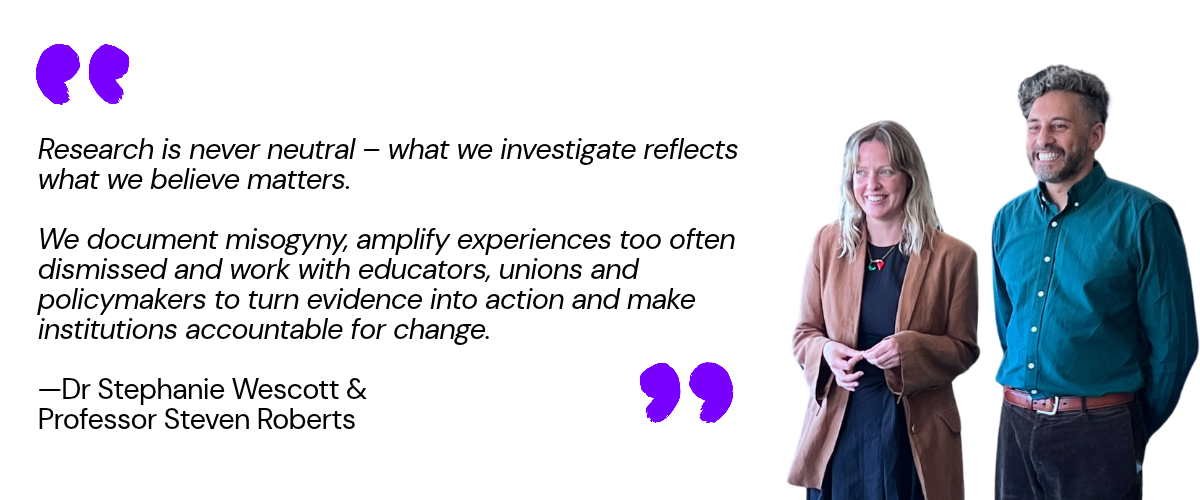
Dr Stephanie Wescott & Professor Steven Roberts
Dr Stephanie Wescott and Professor Steven Roberts are researchers at Monash University. A lecturer in Humanities and Social Sciences, Stephanie’s research examines misogyny and gender-based violence in school settings. A Professor of Sociology, Steven has published widely in critical masculinities studies, including on risky drinking, sexting, the manosphere, computer gaming, emotionality, violence, domestic labour and paid care work. 

The pair recently co-authored a book, Schooling Misogyny, examining how online misogyny is reshaping school cultures and what educators, policymakers and communities can do to respond.  

Drawing on their research into misogyny and the manosphere’s influence in schools, the book connects teachers’ experiences with wider systems of gender inequality, the influence of social media capitalism and institutional power. It provides practical guidance for recognising, challenging and preventing misogyny through curriculum, pedagogy, leadership and whole-school change. 

Stephanie and Steven’s combined research has made a previously under-recognised problem visible and shaped the language that is used to name it. They conducted the world’s first empirical study of Andrew Tate’s influence in education settings and, with the Australian Education Union, produced Duty of Care, a national investigation of sexism, misogyny and sexual harassment in Australian schools that reconceptualised gendered violence in schools as an urgent workplace and education policy issue. 

The work is creating change through policy influence and public engagement. Their findings have informed government reviews and violence prevention frameworks in Australia and internationally. The book translates this evidence into accessible strategies that schools can apply. 

Stephanie and Steven’s work foregrounds the essential place that schools have in the violence prevention system, contributes to the evidence base for prevention, challenges the normalisation of misogyny and supports education institutions to take responsibility for safer, more equitable learning and working environments. 

Learn more about Stephanie and Steven’s work here. 

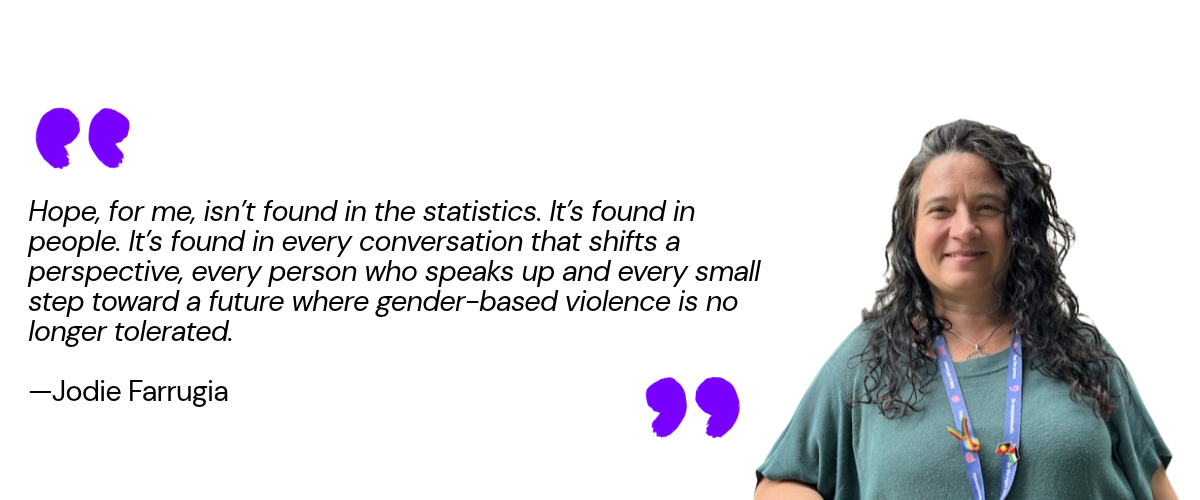
Jodie Farrugia, Centre Against Violence
Jodie Farrugia is the Prevention and Education Facilitator at Centre Against Violence (CAV), designing, coordinating and facilitating a suite of evidence-informed prevention and education programs across the Ovens Murray region. Her work focuses on preventing family and sexual violence through community education, capacity building and the promotion of respectful relationships and gender equality.   

Jodie delivers programs across a range of settings including football and netball clubs, early childhood services, primary and secondary schools, workplaces and community organisations. This includes facilitating formal training programs that build participants’ knowledge and skills to identify and respond to family and sexual violence, as well as recognising and responding to child sexual exploitation.   

A key component of Jodie’s role involves developing and delivering innovative, interactive programs that engage diverse audiences in meaningful discussions about violence prevention. These include:   

  • Tackling Consent, a collaboration with La Trobe University that works with football and netball clubs, young people, mentors, coaches and parents to explore respectful relationships, consent, friendships and positive team culture.   
  • Rhythm and Respect, an early years program that supports children, educators and parents to understand body boundaries, consent and bodily autonomy.   
  • STAND, a community bystander to violence initiative that uses interactive activities and group discussion to build confidence, skills and strategies for challenging harmful attitudes and behaviours within our communities.   

Jodie’s work also includes partnering with local diverse communities to develop tailored prevention initiatives that respond to community needs and experiences.   

Through a variety of facilitation approaches, including workshops, training, community events and collaborative initiatives, Jodie aims to increase awareness, strengthen community capacity and foster critical understanding of the drivers of family and sexual violence. Ultimately, her work supports safer, more respectful and inclusive communities across the Ovens Murray region.  

Learn more about Jodie’s work here.  

Join the campaign!

Want to get involved in Safe and Equal’s 16 Days of Activism campaign? 

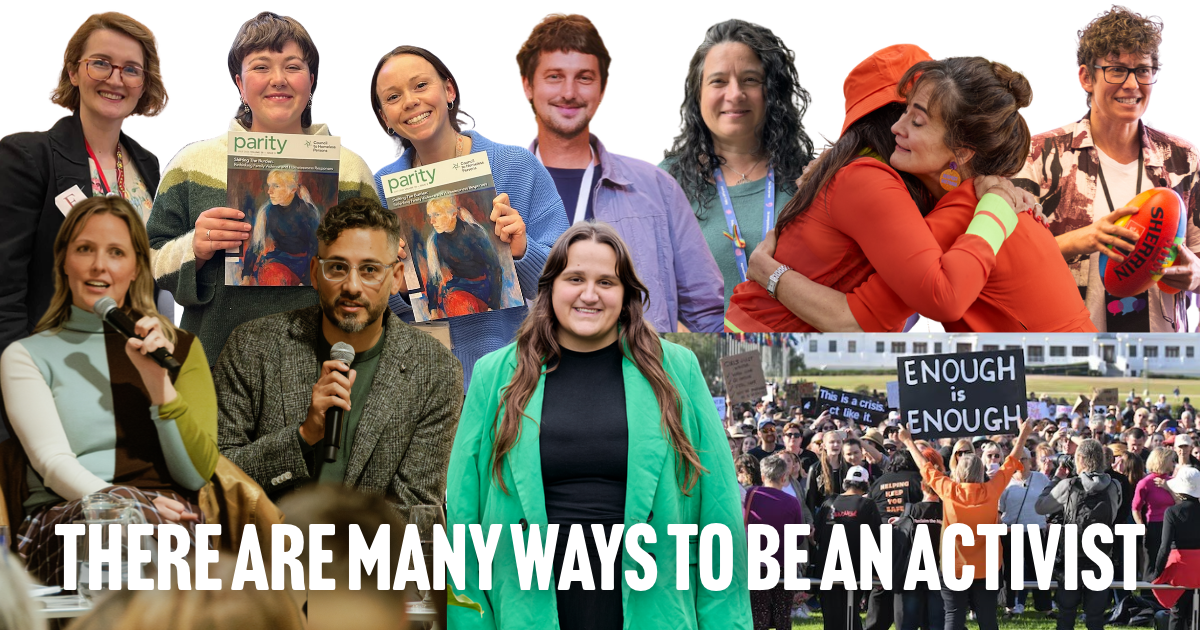
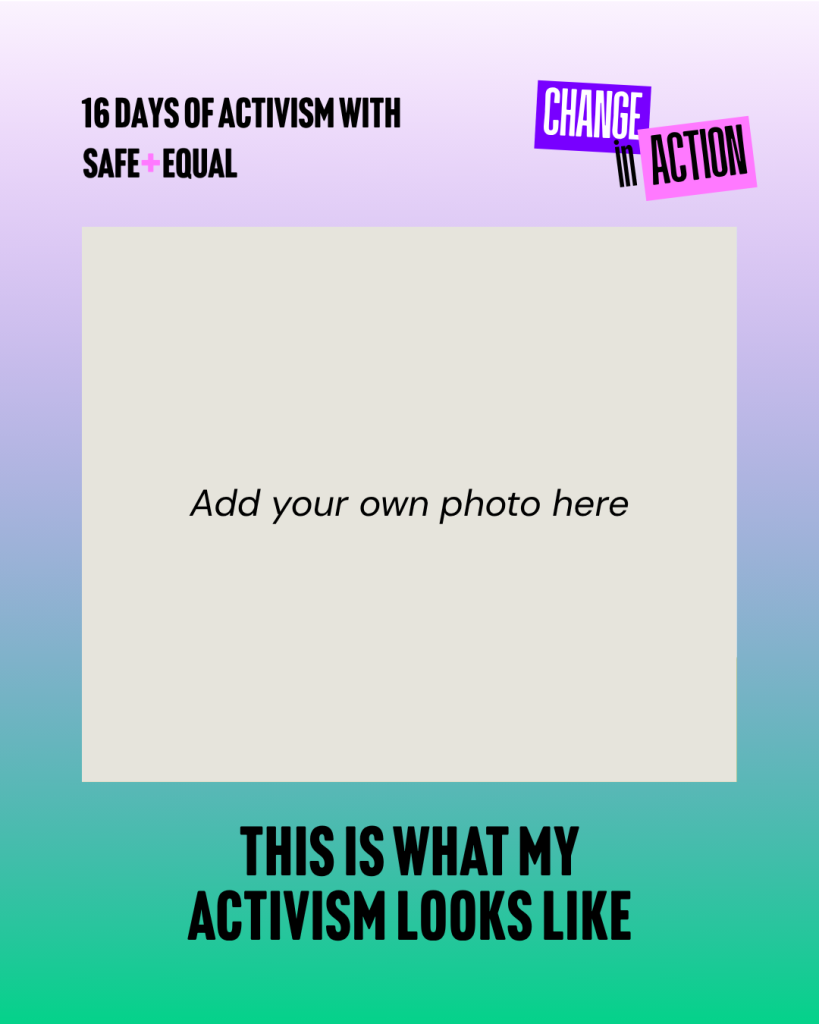
There are many ways to be an activist and we want to see them all! During the 16 Days, we encourage you to post a photo of what your activism looks like. To join the campaign, use the hashtag #ChangeinAction2026 and tag @safe_and_equal and we’ll share your post or story with our audience.  

We have also created custom 16 Days social media templates that you are welcome to use. Simply edit one of the templates below*, add your own image and post. 

We look forward to seeing your change in action moments! 

*You will need to either have an existing Canva account or create one. It’s free to sign up. 

A history of activism against gender-based violence in Victoria

Safe and Equal exists because of the activism, leadership and expertise of victim survivors, practitioners and leaders who have come before us demanding safety and equality. Below is a history of our organisation and the many Victorian changemakers who forged the path.

In the beginning: the refuge movement in Victoria (1970s – 1980s)
Family violence has long affected our community, extending trauma and loss across every level of society.

For most of the last century, family violence was mostly hidden, deemed shameful and seen as an individual or family problem. It was not recognised as a crime until 1975, and before this there were no dedicated services or support for victim survivors. During the 1960s and 1970s, amid the growing women’s liberation movement, feminist activists were shaping and defining understandings of gender and politicising women’s oppression, inherently tied to patriarchy.

Against this backdrop, the refuge movement was born as a direct response for women who were experiencing family violence, and facing homelessness, poverty and social stigma. These activists worked long and hard, mostly as unpaid volunteers, to shine a light on the women and children who were being abused and murdered.

Victoria’s first refuge, the Women’s Liberation Halfway House, was established in 1974. By 1979, sixteen refuges had been established – including the Aboriginal Women’s Refuge (now known as Elizabeth Hoffman House), and dedicated services for Italian women. By the late 1980s, there were more than thirty refuges. In 1987, The Crimes (Family Violence) Act was passed in Victoria, expanding options for family violence victims to seek Apprehended Violence Orders.

This swell of collective action was driven by courageous and visionary women working to dismantle patriarchal power and create a safer world. A core group of leaders within this movement came together to form the Victorian Women’s Refuge Group in 1976, later known as Victorian Women’s Refuges and Associated Domestic Violence Services (VWRADVS).

In 1985, VWRADVS received a small $50,000 grant to fund an advocacy centre. The Domestic Violence and Incest Resource Centre was born.

From the margins to the mainstream: the activist years (1980s – 1990s)
One woman and a typewriter

The Domestic Violence and Incest Resource Centre (DVIRC)’s humble beginnings were fuelled by fierceness and informed by a radical feminist perspective that viewed sexual assault
and family violence as crimes arising from a gendered power imbalance in society.

With the support and backing from VWRADVS, Lynne Burgoyne was employed as the inaugural sole worker of DVIRC. Equipped with her typewriter, Lynne worked tenaciously in the corner of another small feminist organisation, the Women’s Information and Referral Exchange (WIRE), centering child sexual abuse and family violence in DVIRC’s advocacy agenda.

In 1987, DVIRC formed the Women’s Coalition against Family Violence, a network which launched the ‘Domestic Murders Campaign’ – the first major public campaign to recognise family violence deaths. A boost of funding in 1989 provided the opportunity for DVIRC to expand grassroots community activities, with a focus on refugee and migrant women.

Formative years

The early to mid-1990s saw huge shifts in the family violence and sexual assault sectors across legislation, policy and advocacy. In 1991, The Crimes (Rape) Act passed, making significant changes to Victoria’s rape laws including clarifying legal definitions of consent. In this same year, the High Court of Australia confirmed the legal right of women to refuse sex within marriage, and Victoria Police released their Code of Practice for the Investigation of Sexual Assault. The first 16 Days of Activism Against Gender-Based Violence campaign was held in 1991, and the Telephone Services Against Sexual Assault was established providing a state-wide, after-hours service to victims of sexual assault.

Expanding the reach and building impact: the advocacy years (2000s)
From a collective to a peak body

In 2001, family violence was identified as a top priority for Victoria Police by Chief Commissioner Christine Nixon, resulting in the Victoria Police Code of Practice for the investigation of Family Violence. In 2004, a VicHealth and Department of Human Services study identified intimate partner violence as the leading burden of disease for Victorian women aged 15 to 44, followed a few years later by VicHealth’s first survey of community attitudes towards violence against women. One of the most significant statistics to emerge in Australia during this time came from the second Personal Safety Survey conducted by the Australian Bureau of Statistics which showed that one in three Australian women had experienced violence from a male partner. This was a shocking number, and one that pushed conversations around family violence into the collective consciousness.

During this time, the Victorian Government was beginning to listen and take action. The Statewide Steering Committee to Reduce Family Violence was established, the first Women’s Safety Strategy was launched, and VWRADVS was working to establish a policy position within the family violence sector. This work paved the way for the transition of VWRADVS from a grassroots collective to an official peak body for specialist family violence services, known as Domestic Violence Victoria (DV Vic). Janine Bush was the first paid employee, as DV Vic’s Policy Coordinator from 2002. In 2005, Fiona McCormack was appointed as DV Vic’s first CEO.

This was a period of enormous change, as the coordinating collective became a Board of Management. Prior to this, VWRADVS met regularly but had no public profile – Fiona was tasked with establishing DV Vic’s voice and visibility in a way that would represent the sector effectively.

A very small but influential lever for advocacy, DV Vic drove systemic changes and established a key role within statewide coordination, specialist practice development and policy reform.

In 2006, DV Vic developed the first Code of Practice: Principles and Standards for Specialist Family Violence Services Responding to Victim Survivors in Victoria. This was an important moment in DV Vic’s history, requiring the family violence sector to come together and find consensus on practice principles and standards. This was followed two years later by the introduction of the Family Violence Protection Act 2008 from the Victorian Government.

During these advocacy-focused years, DV Vic solidified its position as a key voice of family violence expertise, convening the EVA Media Action Group to improve media reporting on family violence from 2012, and presenting on Victorian family violence reforms to the United Nations NGO Parallel Event on the Convention of the Status of Women in New York and at the Roundtable for United Nations Special Rapporteur on Violence Against Women. This coincided with state government developments, including the release of Victoria’s Action Plan to Address Violence Against Women and Children.

DVIRC becomes DVRCV

In the late 1990s and early 2000s, DVIRC utilised the online space to support victim survivors and family violence professionals, launching their first website in 1997. This was followed in by When Love Hurts (later renamed Love: The Good, The Bad and The Ugly) and Bursting the Bubble, both innovative sites designed for children and young people.

In 2001, DVIRC became a Registered Training Organisation, delivering the first accredited family violence training in the country. By 2007, DVIRC was delivering statewide training on the Family Violence Risk Assessment and Risk Management Framework (often referred to as the Common Risk Assessment Framework, or CRAF, working to support a consistent approach for assessing and managing family violence risk across Victoria.

From its earliest days of one worker and a typewriter, DVIRC had grown its impact and reach to become a hub for family and genderbased violence resources, research and workforce capability building. In 2009, the collective opted to become an Incorporated Association, changing its name to the Domestic Violence Resource Centre Victoria (DVRCV), and appointing its first Executive Officer, Vig Geddes.

In 2013, DVRCV partnered with DV Vic to launch The Lookout website, a single source for specialist family violence practice information and resources. In the same year, DVRCV
launched the SmartSafe website, based on Australia’s first research into technology facilitated abuse. This later led to the development of SmartSafe+, a smartphone app that would go on to win the Premier’s iAward for Public Sector Innovation in 2016.

During these years, there were several key state and federal reforms in the family violence space. In 2009, the Commonwealth Government appointed the first National Council to Reduce Violence against Women and their Children, and the second National Community Attitudes Towards Violence Against Women Survey was undertaken, including Aboriginal and culturally and linguistically diverse communities for the first time. In 2011, the national sexual assault and domestic violence counselling service 1800RESPECT was launched, and in 2013, both Our Watch and Australia’s National Research Organisation for Women’s Safety (ANROWS) were established as initiatives out of the National Plan to Reduce Violence against Women and their Children 2010-2022.

In spite of all these changes, ongoing family and gender-based violence across all communities continued to fuel both DV Vic and DVRCV’s commitment to advocacy and education activity. Between 2010 and 2014, there were several high-profile sexual assaults and homicides that left the community shocked and demanding change.

Building momentum for change: the Royal Commission into Family Violence, and beyond (2014 – 2018)
On 12 February 2014, Luke Batty was murdered by his father in broad daylight, on a suburban cricket pitch in Melbourne. Following years of family violence perpetrated against Luke’s mother Rosie Batty, the system ultimately failed to protect Luke and Rosie. In the aftermath of this unthinkable tragedy, Rosie stood up and joined the calls of many strong advocates before her. Her and Luke’s story struck a chord with Australians, helping to change the national conversation about family violence, leading us to a point of no return.

In this same year, DV Vic, DVRCV and No to Violence (the Victorian peak body for services and practitioners that work with men who use family violence) were funded to manage the rollout and training of Risk Assessment and Management Panels (RAMPs): formally convened meetings comprised of key agencies and organisations to share information and take action to keep people at the highest risk from family violence safe. DV Vic and DVRCV also worked together to establish the No More Deaths alliance, calling for family violence to lead the agenda in the 2014 Victorian state election. This was a year of unprecedented media and community focus on family violence, marking the beginning of enormous changes within the sector. This included the appointment of a new ministerial portfolio for the Prevention of Family Violence, held by Fiona Richardson MP – the first such position in Australia.

In the months following Luke’s death, DV Vic’s CEO Fiona McCormack accompanied Rosie to meet with Victorian Premier Daniel Andrews to demand change. Rosie’s advocacy was instrumental in his decision to call a Royal Commission into Family Violence, a watershed moment that led to unprecedented investment and reforms within the Victorian family violence system for years to come.

A reform agenda

The Royal Commission into Family Violence was held in 2015. DV Vic and DVRCV were key contributors to the proceedings, developing multiple submissions and providing testimony across the 25 days of public hearings. In 2016, the Royal Commission released its report, with the Victorian Government committing to implement all 227 recommendations, followed by an investment of $2.7 billion to support this.

Focus on the family violence sector was at an all-time high, resulting in dramatic organisational shifts for both DV Vic and DVRCV.

During this time, DVRCV tripled in size. Under the leadership of a new CEO, Emily Maguire, the organisation’s strategy focused on building capability across sectors, positioning DVRCV as the go-to voice on workforce development for the family violence and primary prevention sectors. The time had come to re-focus DVRCV’s strategic direction, which meant closing the organisation’s library.

2016 saw the release of Victoria’s first gender equality strategy Safe and Strong, followed by Free from Violence, the State Government’s strategy to prevent all forms of family violence and violence against women, placing the spotlight on primary prevention. Post-Royal Commission, the expansion of DVRCV saw the establishment of a dedicated prevention team, expanding the Partners in Prevention program established back in 2007 to support the delivery of respectful relationships education initiatives in schools.

In 2018, DVRCV hosted the first primary prevention conference on ‘Achieving Generational Change’. Rebranded as PreventX, the conference grew and evolved in 2019 and then online in 2020, demonstrating a shift in Victoria from a nascent prevention sector to one that was becoming more established and resourced.

During this time, the culture of DVRCV was one of feminism, hard work and camaraderie – going above and beyond to create opportunities for lightness and positivity to help make the heavy work sustainable for staff. DV Vic also grew exponentially in the years following the Royal Commission, establishing a practice development unit in 2017 to ensure members were appropriately resourced to sustain and strengthen their specialist family violence practice.

More broadly, the sector was becoming more professionalised. In 2016, the Victorian Government established both the Family Violence Steering Committee (with DV Vic’s CEO and the Minister for the Prevention of Family Violence as co-chairs) and the Victim Survivors’ Advisory Council, to place people with lived experience of family violence at the centre of reforms. 2017 saw the release of Building from Strength: 10 Year Industry Plan for Family Violence Prevention and Response, as well as the establishment of Family Safety Victoria to lead the implementation of the government’s family violence reforms. The Common Risk Assessment Framework (CRAF) was reviewed and re-developed, becoming what is now known as the Family Violence MultiAgency Risk Assessment and Management Framework (MARAM).

In 2019, DV Vic published the Second Edition of the Code of Practice: Principles and Standards for Specialist Family Violence Services Responding to Victim-Survivors in Victoria. Building on a significant resource that informed the development of Victoria’s family violence sector over many years, the second edition of the Code of Practice retained a specialist, intersectional feminist lens on family violence work as the sector became more joined up with the mainstream Victorian human services system.

A united vision (2019 – beyond)
For more than three decades, DVRCV and DV Vic (and their previous iterations) have been two key organisations within a broader social movement working to push family violence into the public domain. In partnership with member services, victim survivors, community leaders, and government partners, both organisations have led the establishment and coordination of the specialist family violence sector in Victoria, frequently sharing positions in advocacy and campaigning. Informed by each other’s skills and expertise, the respective roles in the Victorian family violence system held by DV Vic and DVRCV have always been complementary.

In 2019, as the sector moved into a new phase of systemic reforms, the Boards of DV Vic and DVRCV identified that a merger would grow the capacity of the peak to listen to and support the work of frontline services, reflect members’ experience, and embed the voice of lived experience in policy, advocacy and systems reform work.

Following a robust consultation process, their Boards and members voted in favour of an organisational merger in 2020, with Tania Farha appointed as the CEO of the new entity soon after.

Combining strengths, energy and resources for greater impact, this merge represented a new chapter in the long histories of two well–respected organisations, further widening the lens of the family violence sector to ensure all voices and experiences are understood and included.

In 2021, Safe and Equal launched as the new peak body for specialist family violence services responding to victim survivors in Victoria. With a new name and united vision, Safe and Equal will work towards a world beyond family and gender-based violence, where women, children and all people from marginalised communities are safe, thriving, and respected.

Safe and Equal exists because of the activism, leadership and expertise of victim survivors, practitioners, and leaders who have come before us demanding safety and equality.
To them, we say thank you.

DO YOU NEED FAMILY VIOLENCE SUPPORT?

If you or someone you know is in immediate danger, call triple zero (000).

If you are experiencing family violence, there are services that can provide support and advice.

For support across Australia, contact 1800 RESPECT (1800 737 732) or visit 1800respect.org.au.