
Safe and Equal
State Election Platform 2026

Because of what Victoria has built, thousands of children who would have grown up in violence didn’t. Now we have an opportunity to build on that progress.
Victoria leads the nation on tackling family and gender-based violence. Every other state is watching what we do next.
Spend $554 million to realise $2.8 billion in benefits to victim survivors and the state and help to bring down the $8.9 billion family violence already costs Victoria every year.
This is prevention of a cost, not new spending.
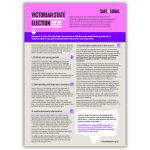
This Communications Toolkit includes social media assets, a media release template, MP email templates and other resources to help you advocate for family violence investment this election.
Victoria’s decade of reform is working – and it’s not finished. Police recorded 106,430 family violence incidents in 2024–25, a reminder of how much is still being asked of a system that sustained investment has made stronger than ever.
Ahead of the 2026 Victorian election, here is what the family and gender-based violence sector is asking of all parties to keep that progress moving:

Children and young people
Access to services for children and young people
Investment is needed to ensure skilled and coordinated services are available to all children and young people experiencing family violence, who face distinct challenges in accessing support as victim survivors in their own right.
At least 40 per cent of specialist family violence service case management clients are children and young people. A guaranteed $33 million a year, quarantined as part of core investment, would support effective and skilled services designed to meet their needs.
An additional $12 million annually over five years is necessary for the sector to deliver 10 multidisciplinary demonstration projects for children and young people – building workforce capability and system-wide learning about what works for this cohort.
Safe housing and long-term recovery
Refuge and housing for victim survivors
Family violence is the leading cause of homelessness for women and children, who should never have to choose between violence and having nowhere safe to go.
By at least doubling specialist refuge capacity and delivering 83,000 new social housing dwellings for victim survivors over the next 25 years, much of this gap would be closed.
Sustained investment is needed to increase refuge services and safe, affordable, long-term housing options.
Long-term recovery for victim survivors
Case management, delivered by specialist family violence services is highly effective, but many victim survivors need longer-term, holistic support to rebuild their lives – including therapeutic care, peer-to-peer support, and pathways back into education and employment.
Additional investment for specialist family violence services and broader programs and services would support these models and pathways, such as peer-to-peer support and initiatives to improve victim survivors’ access to education and employment.
Justice and early intervention
Access to justice for victim survivors
Most victim survivors don’t qualify for publicly funded legal support and can’t afford a private lawyer, leaving a legal assistance sector that needs additional investment to meet demand.
As coercive control laws come into force, victim survivors also need protection from misidentification. A $15 million commitment is required to ensure public awareness and community engagement – through legislative safeguards, targeted campaigns and attention to the concerns of overpoliced communities.
Early intervention to stop violence
An immediate $20 million investment in early intervention would allow specialist services to reach people at risk before crisis point, coordinating with schools, healthcare, social services and legal services along the way.
Sustainable investment in the sector
Core investment for specialist family violence services
The core investment for the sector needs to grow to $554 million per year from 2026–27, delivered through minimum five-year funding commitments. Economic modelling shows this investment would return $2.8 billion in benefits to victim survivors, communities and the Victorian economy – around six times the cost of investment – while helping reduce the $8.9 billion family violence costs Victoria each year.
Specialist family violence services are the frontline services supporting victim survivors of family and gender-based violence. Demand for these services is rising and investment has not kept pace, resulting in longer wait lists and increased pressure on workers. Investment should be prioritised around outcomes for victim survivors and their families, with targets and reporting co-developed with the sector.
This includes funding community-led services and building capability across the service system to meet the needs of Aboriginal and Torres Strait Islander communities, migrant and refugee communities, multi-faith and multicultural communities, women living with disabilities and LGBTIQA+ communities, as well as investment across all regional and rural areas of Victoria.
It also includes meeting the needs of victim survivors across the life course, including children and young people, and older people.
A strong specialist sector remains central to this work. It holds deep knowledge and practice expertise developed through decades of feminist-led service delivery, and plays a central role in coordinating, leading and developing the capability of the broader service system.
Certainty for prevention programs
Five-year minimum funding commitments, through a dedicated prevention investment stream and a further $20 million per year is critical to support the long-term impact of violence prevention.
Stopping family and gender-based violence before it starts means changing attitudes, cultures and society as a whole. Primary prevention of family and gender-based violence means addressing the specific ways gender inequality makes violence more likely, alongside systems like racism, ableism, homophobia and transphobia, so that violence of any kind is no longer excused or minimised.
A system of prevention initiatives is already in place across the state, in schools, local councils, and through the work of women’s health services and specialist family violence and sexual assault services. Community-led programs ensure this work includes and works effectively with Aboriginal and Torres Strait Islander communities, migrant and refugee communities, women living with disabilities and LGBTIQA+ communities, with elder abuse prevention also a focus.
This system has reached a point where sustained investment can accelerate the change already underway.
Supporting the frontline and prevention workforce
None of this holds without a skilled, well-supported workforce – through job security, fair pay, professional development and attention to wellbeing.
A skilled and expanded specialist workforce must be supported to deliver programs and services across the state that can meet the needs of victim survivors and prevent violence in the future.
Sustainable investment in primary prevention also supports retention of the people doing this work on the ground, building the skills, support and connection needed by the growing number of people and organisations joining this movement for change.
System governance to ensure effectiveness and impact
These commitments only work if the system delivering them is accountable.
Key aspects of system governance need investment and sustained attention to ensure these commitments achieve their aims, including reinstating an independent system monitor to support government accountability and monitoring of system performance and impact, and to continue driving a whole of government approach.
Maintaining Family Safety Victoria as a specialised and expert governance agency is also part of this work, alongside codesigned reporting that allows the sector to focus on quality and outcomes. Lived experience of family violence should continue to play a central role in policy and service system design, with structures and processes that embed it developed and supported across the sector.
Sustained and increased investment in Safe and Equal supports its role as the peak body providing a collective voice for the family violence and gender-based violence sector and leading future system reform, including policy analysis and advocacy, communications that inform public discussion, practice leadership, sector development, and workforce training and leadership programs, in partnership with our members, partners, stakeholders and the Victorian Government.
Sustained investment in Safe and Equal itself – as the peak body coordinating this work, providing policy analysis, advocacy, practice leadership and workforce training across the sector – is part of what makes this progress hold.

“Family and gender-based violence is preventable and must be a priority for all parties as we approach the 2026 election. We need the incoming Victorian Government not just to maintain the system we’ve built, but to strengthen it for the future. Fund the family violence system like lives depend on it – because they do.”
– Safe and Equal CEO Dr Joumanah El Matrah.
RELATED
PAGES