

PreventX Program 2026
We are thrilled to share the finalised program for PreventX 2026: Stories for Change.
With 16 parallel sessions and a plenary session to open and close each day, delegates will hear from those leading prevention work across systems and settings, in their communities and workplaces.
- Day one we will look at storytelling as a prevention skill we use in our work
- Day two will dive deeper into stories from prevention in practice
- Day three will be online workshops
Explore the full program below or download the program PDF here.
This program is current as at 19 March 2026.
DAY 1: Tuesday 24 March 2026
| START TIME | SESSION | |||
| 8 – 9:30am | Registration opens | |||
| 9.30 – 9.45am | Welcome to Country (livestreamed) | |||
| 9.45 – 9.50am | Ministerial welcome (livestreamed)
The Hon. Ged Kearney, Commonwealth Assistant Minister for Social Services and Assistant Minister for Prevention of Family Violence |
|||
| 9.50 – 10.05am | Conference opening and setting the scene (livestreamed)
Marina Carman, Safe and Equal |
|||
| 10.05 – 11.15am
|
Opening plenary (livestreamed) Storytelling on Country: First Nations primary prevention |
|||
| Moderator: Adele Cox, Adele Cox Consulting | ||||
| Speakers: – Regan Mitchell, Our Watch – Selena O’Meara, Kimberley Aboriginal Women’s Council – Kowana Welsh, Women and Girls Emergency Centre |
||||
| 11.15 – 11.45am | Morning tea | |||
| 11.45am – 1pm
|
Session 1 Stories from multicultural and faith-based communities |
Session 2 The future is local |
Session 3 Stories from the frontline: the trans women and our allies transforming the prevention sector |
Session 4 Yarning circle: safety, acceptance, identity on Country |
| GenWest Voices of change: stories of community-led prevention, by the community, for the community |
Municipal Association of Victoria | Zoe Belle Gender Collective |
Restorative Yarns | |
| Women’s Health in the South East Culture, connection and change: migrant women leading prevention through storytelling |
||||
| PRONIA Stories for change in multicultural communities: prevention across generations |
||||
| 1 – 2pm | Lunch (including optional PiP Connect for online audience) | |||
| 2 – 3.15pm
|
Session 5 (livestreamed) It began in the West … almost a decade of adaptation, the story of Working Together with Men |
Session 6 Young Luv: Aboriginal-led program design |
Session 7 Stories of lived and living experience |
Session 8 Stories from the frontline of Respectful Relationships education |
| RMIT University in collaboration with Melbourne Playback Theatre and Women’s Health Grampians | Djirra | Professor Anatasia Powell The story in-between: centering survivors in primary prevention work |
Victorian Department of Education and Respectful Relationship workforce
|
|
| Women’s Health Grampians Living expertise as a primary prevention tool: the Intersectionality Workbook and its practical applications |
||||
| Anchor Point Therapy & Innovative Resources Shame to safety: stories that prevent family violence |
||||
| 3.15 – 3.45pm | Afternoon tea | |||
| 3.45 – 4.45pm
|
Closing plenary (livestreamed) Informing policy making: how and when do stories matter? |
|||
| Moderator: Tania Farha, InTouch Multicultural Centre Against Family Violence | ||||
| Speakers: – Micaela Cronin, Commonwealth Domestic, Family and Sexual Violence Commissioner – Moo Baulch, Our Watch and WAGEC – Michelle Reddy, Pacific Feminist Fund – Dr Anna Cody, Sex Discrimination Commissioner |
||||
DAY 2: Wednesday 25 March 2026
| START TIME | SESSION | |||
| 9 – 9.15am | Welcome to Country (livestreamed) | |||
| 9.15 – 9.20am | Opening day 2 (livestreamed)
Chris Mathieson, Safe and Equal |
|||
| 9.20 – 9.30am | Ministerial address (livestreamed)
The Hon. Ingrid Stitt, Victorian Minister for Prevention of Family Violence |
|||
| 9.30 – 10.45am | Opening plenary (livestreamed) Stories of gender transformative practice and change |
|||
| Moderator: Amelia Ditcham, Safe and Equal | ||||
| Speakers: – Steve Roberts, Monash University – Starlady, Zoe Belle Gender Collective – Sarah Drury, Men and Family Centre – Chay Brown, HerStory Consulting |
||||
| 10.45 – 11.15am | Morning tea | |||
| 11.15am – 12.30pm | Session 9 Stories from prevention workforce development |
Session 10 Stories of working with young people in prevention |
Session 11
The Game: an immersive game-based workshop about LGBTIQA+ inclusion in sport and recreation |
Session 12 Stories from research and program impact |
| Multicultural Centre for Women’s Health Amplifying bilingual voices: investing in a critical workforce for community-led prevention |
Centre for Multicultural Youth Youth-led change: the Speak Up program and the future of inclusive family violence prevention |
Proud2Play | Respect Victoria Collect once, use often: Insights from secondary analysis of National Community Attitudes Survey (NCAS) data from Victoria |
|
| Our Watch Strong foundations, strong futures: sustaining primary prevention efforts |
Our Watch Changing the story for young people: complementary and reinforcing prevention approaches where young people learn, play and engage |
Our Watch Sharing stories of change: monitoring population-level progress in primary prevention |
||
| Domestic Violence NSW The NSW Primary Prevention Collaboration: a NSW story of primary prevention practice, advocacy and growth |
Australian Muslim Women’s Centre for Human Rights Navigating Halal and Haram: conversations on relationships, consent and safety with young Muslim women |
Jesuit Social Services – The Men’s Project Unpacking the Adolescent Man Box research and practice implications |
||
| Women with Disabilities Victoria From fear to confidence: embedding gender and disability-inclusive prevention |
||||
| 12.30 – 1.30pm | Lunch | |||
| 1.30 – 2.45pm | Session 13 More than a setting: primary prevention and digital lives |
Session 14 Stories to advance practice in the early years |
Session 15 Stories from sport |
Session 16 Stories across the prevention continuum |
| Respect Victoria | FVREE Gender equity in the early years: engaging parents, educators and children through storytelling |
The Sexual Assault and Family Violence Centre Why sport? The respect starts here story |
Safe and Equal, Jesuit Social Services – The Men’s Project and Women’s Health Grampians Prevention in response: bridging the gap to embed prevention in everyday practice |
|
| The Global Institute for Women’s Leadership at the Australian National University | Women’s Health Loddon Mallee Raise them equal- gender in the early years |
Crash the Boards Primary prevention in sport: Crash the boards |
Centre for Non-Violence Frontline services – the missing link in prevention! |
|
| University of Melbourne | healthAbility Stories of systems change: Baby Makes 3 in action |
Rainbow Health Australia Connecting the dots between homophobia, misogyny and transphobia through a focus on sport and masculinities |
Settlement Services International Conversations for prevention: transforming social norms in the context of refugee settlement |
|
| Body Safety Australia | Better Health Network Moving beyond neutral: aligning practice with the story you want to tell about gender equity in the early years |
CatholicCare NT Playing the long game: sport as a catalyst for community-led prevention |
||
| 2.45 – 3.15pm | Afternoon tea | |||
| 3.15 – 4.15pm | Closing plenary (livestreamed) Stories for change: where to next? |
|||
| Moderators: Hannah Dwyer and Meghan Cooper, Safe and Equal | ||||
| Speakers: – Jay Jones, Body Safety Australia- Sharmilla Falzon, Domestic Violence NSW – Nagma Shaik, Women’s Health and Equality Queensland – Lena Molnar, Women with Disabilities Victoria- Alicia Gibbs, Preventing Violence Together WA |
||||
| 4.15 – 5.15pm | Ongoing networking, drinks and nibbles | |||
Our quiet and support space will be running across the two days of the conference. Restorative Yarns is honoured to provide the Grounded-on Country wellbeing space.
Read more about the supports offered and the quiet space program here.
Workshops: Thursday 26 March 2026
On Thursday 26 March, we are excited to bring PreventX 2026 participants three dynamic online workshops designed to help you translate the conference’s key themes into practical tools and strategies. These sessions are interactive, practice-based and deeply connected to our theme: Stories for Change. Spaces are limited!
- Workshop tickets are sold separately to complement your in-person or livestream tickets.
- Participants can only attend one workshop as tickets are limited in capacity.
- Each workshop can host 30 participants and we ask that no more than two people join from the same organisation.
- Workshops will not be recorded.
- Workshops will run for four hours between 10am – 2pm with a 30-minute lunch break.

Does this feel dignifying? The power of storytelling: haunting, healing and the ethics of voice
Facilitated by Morgan Cataldo
Thursday 26 March 2026,
10am – 2pm

Stories of equity building in partnerships
Facilitated by Jackson Fairchild and Meghan Cooper
Thursday 26 March 2026,
10am – 2pm

An introduction to Indigenous data sovereignty and two worlds understanding, measurement, evaluation and learning
Facilitated by Kowa Collaboration
Thursday 26 March 2026,
10am – 2pm
Storytelling sits at the heart of how we understand people, relationships and systems. In our sector, the way stories are shared and interpreted carries real influence, shaping practice, culture and outcomes. This workshop at PreventX 2026 creates space to explore how we can engage with stories in ways that uphold dignity, agency and justice.
Drawing on lived experience and systems practice, the session introduces practical frameworks for ethical storytelling. Facilitated by Morgan Cataldo, a leading practice innovator and strategist in ethical storytelling and systems change, it blends lived experience insight with tools to strengthen narrative practice. Participants will examine their roles as storytellers, witnesses and institutional narrators, explore ethical tensions around consent and representation, and work with frameworks such as a cost–opportunity matrix to support more intentional, non-extractive approaches.
Designed for practitioners, leaders and policy professionals, this session offers a grounded, action-oriented foundation for embedding dignity-centred storytelling across programs, partnerships and organisational culture.
Collaboration and partnership are essential in primary prevention. It increases reach and impact, strengthens policy and advocacy, and makes programs more relevant to the communities they aim to reach and serve. This is because different stakeholders bring distinct responsibilities, resources, and expertise that, together, extend what any single organisation can achieve.
Despite this, organisations often put a lot of thought into how programs are designed, but little into how relationships within a partnership are built and maintained to support those programs. As a result, challenges such as power imbalances and inequities creep in. Without care and proper attention, partnerships can replicate harm and exclusion, reproduce colonial practices, reinforce hierarchies, and silence those most affected by the inequities that primary prevention seeks to address.
This workshop will take a storytelling approach to exploring how equity can be built and maintained through partnership. The workshop has been designed for those who are actively involved in collaboration or delivery work through partnership. Experience of working in a partnership will be assumed and a level of understanding of the benefits and challenges of working in partnership. Drawing on participant experiences, and a forthcoming Safe and Equal resource on this very topic, participants will learn about fundamental concepts of partnership, and practice storytelling techniques to explore a key partnership challenge – power imbalances.
This workshop introduces participants to 2WUMEL, a First Nations–led framework that reshapes the way organisations understand impact, measure change and embed learning. Grounded in Indigenous knowledge systems, 2WUMEL offers a holistic and culturally grounded approach that places community leadership, relational accountability and Indigenous Data Sovereignty at the centre of evaluation and decision-making.
Throughout the session, participants will explore how 2WUMEL combines traditional ways of knowing with contemporary evaluation practice, creating a meaningful and integrity-driven foundation for understanding what works and why. The workshop will unpack how culturally anchored learning systems can strengthen programs and services, build genuine partnerships, and support organisations to move beyond extractive approaches.
Facilitated by Kowa Collaboration, this session offers a reflective and practical learning environment for practitioners who are seeking to deepen their capability in culturally responsive evaluation. Attendees will leave with a clearer sense of how storytelling strengthens ethical, community-driven approaches to learning, impact and change.
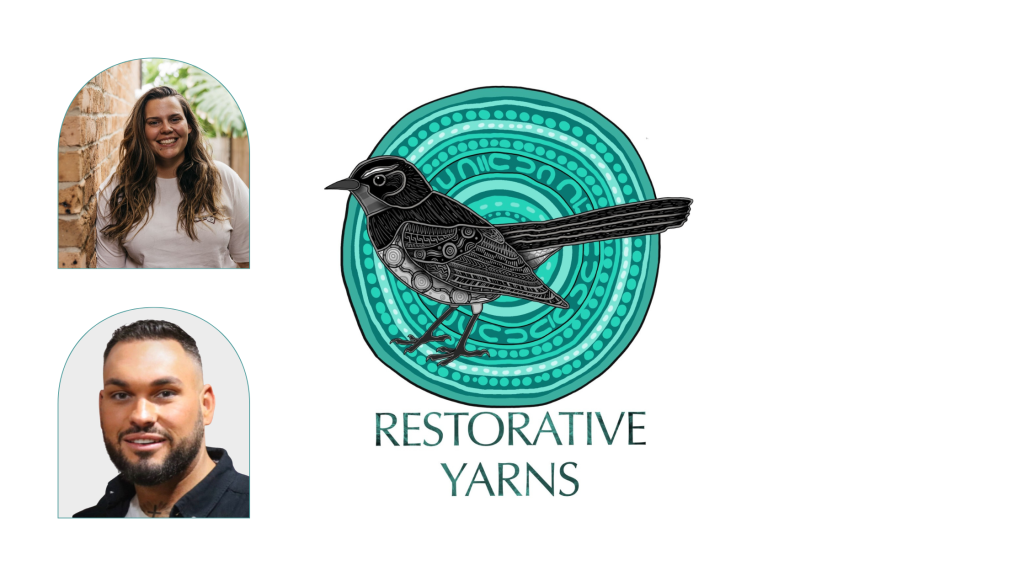
Restorative Yarns
Restorative Yarns is a therapeutic consultancy service that weaves old ways and new ways of knowing, being and doing to support healing, wellbeing and recovery. Grounded in a social justice and human rights framework, Restorative Yarns draws on a decolonial approach, acknowledging the ongoing impacts of colonisation while centering cultural wisdom and culturally safe, trauma-informed care. They offer a range of services including consultancy, counselling, supervision and therapeutic practices designed to empower individuals and communities through culturally responsive support and meaningful healing.
At PreventX 2026, Restorative Yarns is honoured to provide the Grounded on Country wellbeing space – a supportive area where delegates can pause, ground, reflect and connect throughout the event. This space, held by clinicians, is available for people to yarn together, sit quietly, breathe, or rest in a way that feels right to them, acknowledging that everyone cares for themselves differently and that wellbeing looks different for each person.
Restorative Yarns are also available to support delegates experiencing distress or in need of one-on-one support throughout the conference.
Facilitators:
Sam Ivancsik is a proud LGBTQIA+ SB Wiradjuri woman from the South Coast of NSW (she/her). Sam brings over a decade of experience working across child protection, domestic and family violence, sexual assault and supporting children and young people affected by problematic and harmful behaviours. She holds a Bachelor of Social Work and integrates somatic-based practices and technologies like biofeedback into her therapeutic work, alongside culturally informed care.
Locky Bygrave (he/him) is a proud LGBTQIA+ SB Kamilaroi/Gamilaroi man and First Nations Social Worker with extensive clinical experience across the lifespan. Locky’s practice centres strengths-based, culturally responsive, and trauma- and violence-informed approaches, with a deep commitment to enhancing wellbeing and supporting those impacted by complex trauma and sexual harm.
Together, Sam and Locky hold this space with care, cultural awareness and gentle support, – inviting delegates to enter Grounded on Country when they need a moment of rest, reflection, somatic grounding or connection.
| Tuesday 24 March | Wednesday 25 March | |
| START TIME | SESSION | SESSION |
| 9am – 1pm | (No specific activity offered while Restorative Yarns are delivering a parallel session.) | Collective care yarn
Collective Care Yarn is a facilitated reflective space using Sacred Embers cards to explore the ethics and values that guide our work. Through shared reflection and conversation, participants are invited to consider how collective care— rather than individual endurance—can be a meaningful way of resisting burnout. This activity centres slowing down, listening and making sense of our experiences alongside others. The Sacred Embers prompts support discussion around responsibility, limits, solidarity and sustainability in this work, with an emphasis on what it means to care for ourselves and each other within shared systems and contexts. The focus is not on problem-solving or productivity, but on connection, reflection and reaffirming values that make this work possible to continue. |
| 2 – 4.45pm | Creating weighted cushions
In this hands-on workshop, participants will create their own weighted cushion using fabric and filling of their choice. The process involves measuring, assembling and filling the cushion to a preferred weight, allowing for personal customisation. Weighted cushions can provide steady, grounding pressure and are often used as a sensory or somatic support. This session focuses on the practical making process while offering space for participants to notice how weight, texture and pressure feel in their body. No sewing experience is required. All materials are provided and participants can work at their own pace.
|
‘What I want to remember’
This activity invites delegates to write a short letter to themselves, using guided prompts to reflect on what they want to remember from this conference. The prompts encourage reflection on key learnings, stories for change shared across the two days, and the hopes and possibilities these have sparked for what primary prevention of gendered violence could look like moving forward. Participants are invited to name what they want to carry with them – values, commitments, questions, or dreams and how they hope this conference will continue to shape their thinking and practice over time. Letters can be taken home by participants or collected and held by the Safe and Equal team to be posted to participants six months after the conference. This offers a way of reconnecting with reflections and hopes in the future. Participation is optional and there is no expectation to share what you write. |
| 4.45 – 5pm | Winding down
A gentle end-of-day space facilitated by the team, offering guided somatic exercises and light stretching to help the body settle. Participants are invited to slow their pace, release accumulated tension, and transition out of the day in a calm, supported way. No experience is required. |
Winding down
The day will close with a guided meditation facilitated by clinicians, offering a quiet space to settle the body and mind after the conference. This session is designed to support rest, integration of the day’s content and as a gentle transition out of the program. The meditation will be accessible and optional, with participants invited to engage in a way that feels comfortable for them. |
About PreventX
PreventX is one of the largest single gatherings of professionals working to prevent family and gender-based violence in Australia. First held in 2019, PreventX is Safe and Equal’s national conference for those who want to create change and prevent violence.
The conference in 2026 will be held face-to-face in Melbourne, with online components. We are inviting abstracts for parallel sessions to be delivered as a part of the face-to-face conference.
PreventX: Stories for Change is about sharing the stories of primary prevention and how storytelling is a powerful and effective way of creating and demonstrating change. Storytelling is also a useful way to connect with people and Country. First Nations communities are the original storytellers in so-called Australia. Stories for Change is about recognising and celebrating the range of ways in which primary prevention is practiced and inspiring the future. Equally, it is about surfacing the stories of change that need to be shared and understood from a range of views and experiences. Through the art of storytelling, PreventX will tell us about the people, places and processes that are at the core of primary prevention.
